Ashwagandha and Lion's Mane: What the Research Says So Far
Highlights
- Ashwagandha may offer modest short-term benefits for stress and sleep, but preparations differ and long-term safety is less clear.
- Lion's mane has intriguing potential for cognition, with human benefits still uncertain and inconsistent.
- A mushroom or herb name does not identify a standardized product. The extract, plant part, and amount matter.
- Combining both ingredients does not establish that the mixture works better than either one alone.
One promises a calmer evening. The other promises a sharper morning. Ashwagandha and lion's mane have become popular answers to a very modern request: please help my brain deal with all of this.
It is an understandable request. Feeling stressed, distracted, or tired can make ordinary days harder than they need to be. A convenient supplement is appealing, especially when its packaging suggests calm focus without much effort.
Both ingredients deserve a closer look, but they belong in different conversations. Ashwagandha is a plant with potential effects on stress and sleep. Lion's mane is a mushroom with possible cognitive effects. Neither is a universal upgrade, and the details are more useful than the buzzwords.
One is a plant with a modest case for stress and sleep. The other is a mushroom with promise and a lot of open questions.
The short version
Meet the Herb and the Mushroom
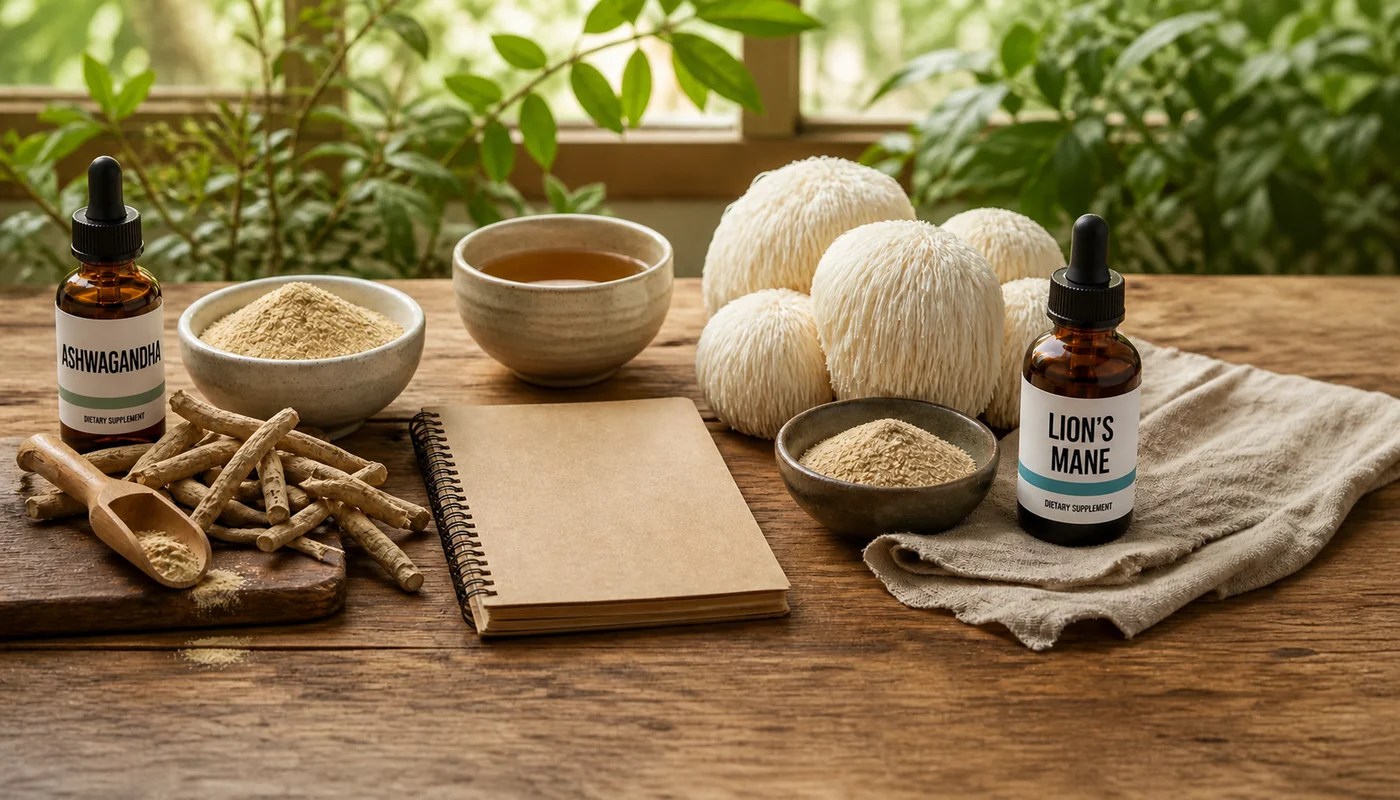
Ashwagandha, also called Withania somnifera, has a history of use in traditional Indian medicine. Modern supplements commonly contain extracts of the root, although some include leaves or a combination of plant parts.
Lion's mane, Hericium erinaceus, is an edible mushroom with a shaggy appearance that explains its memorable name. Products may contain the fruiting body, the threadlike mycelium, or extracts made from these materials.
Those descriptions are not interchangeable. A root powder is different from a concentrated root extract. A serving of cooked mushroom is different from a capsule containing a selected mushroom extract.
Traditional use and culinary familiarity can provide context, but neither establishes that every concentrated preparation delivers a health benefit. The identity of the product matters as much as the identity of the ingredient.
Ashwagandha's Most Plausible Role Is Fairly Specific
Some ashwagandha preparations may reduce perceived stress and improve aspects of sleep over several weeks. That is a more defensible expectation than instant relaxation, permanent resilience, or a complete hormonal reset.
The possible benefit is generally modest and does not appear consistently in every setting. People with higher stress or sleep difficulties may have more room to improve than someone who already sleeps comfortably and feels well.
Feeling somewhat less stressed is also different from treating an anxiety disorder. Ashwagandha should not replace established care for persistent anxiety, depression, or insomnia. If distress is interfering with work, relationships, or everyday activities, a more direct treatment plan can matter much more.
It helps to define a practical goal before considering a product. Fewer evenings spent feeling wound up is a clearer target than becoming stress-proof. No supplement can reasonably promise that your inbox will stop having opinions.
Better Sleep Does Not Mean Stronger Sedation
Possible sleep benefits include improvements in perceived quality and, in some circumstances, the time it takes to fall asleep. The effects are not established as a reliable same-night rescue for occasional sleeplessness.
A product that makes you drowsy is not necessarily improving the whole night's sleep. Daytime alertness, how often you wake, and how you function the following day are useful parts of the picture.
If bedtime keeps shifting or sleep time is routinely squeezed by work, an herb cannot supply the missing hours. A consistent opportunity to sleep remains essential. Persistent insomnia may also need structured treatment rather than a succession of calming supplements.
For someone evaluating ashwagandha, this means tracking a real outcome over an appropriate period rather than waiting for a dramatic sensation. The absence of a noticeable sedative effect does not automatically mean a product is inactive, and heavy grogginess is not a badge of success.
Cortisol Is Not an Enemy to Eliminate
Ashwagandha is often discussed alongside cortisol, a hormone involved in the stress response. Cortisol also has normal, necessary roles in metabolism and other body functions. Its level changes during the day.
Lowering one cortisol measurement does not automatically prove better health. Nor does feeling tired, having a stressful week, or noticing a change in body shape establish that cortisol is abnormally high.
Terms such as adrenal fatigue can make a complicated set of symptoms sound neatly explained, but that label is not an established medical diagnosis. Genuine adrenal disorders are different conditions that require proper testing and treatment.
The word adaptogen is similarly broad. It describes a proposed ability to help the body respond to stress, not a guarantee that a supplement detects and corrects whatever is wrong. It is useful to translate that attractive label back into a specific question: does this preparation help a particular symptom enough to be worthwhile?
Lion's Mane Has Promise, With More Unanswered Questions
Lion's mane contains several groups of compounds, including hericenones, erinacines, and beta-glucans. Some have interesting effects on biological pathways related to nerve cells. That helps explain the interest, but activity in cells or animals does not establish that a supplement improves human memory.
Possible improvements in certain cognitive tasks have appeared with some preparations. Other outcomes have shown little or no benefit. A consistent, meaningful improvement in everyday cognition for healthy adults has not been established.
That distinction matters because cognition includes many abilities: attention, remembering information, processing speed, planning, and more. Performing faster on one task is not the same as improving all of them.
The sensible expectation is therefore cautious curiosity. Lion's mane is not proven to prevent dementia, reverse cognitive decline, repair nerves in people, or treat attention disorders. Those are much larger claims than its current human results can support.
A Memory Claim Needs an Everyday Meaning
Suppose someone feels more productive after adding a mushroom drink to the morning routine. Several explanations are possible. The drink may also contain caffeine. They may have started sleeping more regularly, eating breakfast, or taking a short break before work.
That does not make the experience imaginary. It means the cause is difficult to identify, especially when several things change together. A personal impression can be useful without establishing what an ingredient does for everyone.
For an individual goal, choose something concrete, such as whether you can stay with a familiar task comfortably. Avoid repeatedly taking online memory tests and treating a small score change as a diagnosis or proof of brain growth.
New or worsening memory problems deserve assessment rather than a supplement experiment. Sleep problems, medications, mood, nutritional issues, and neurological conditions can all be relevant, and some require a different response entirely.
The Extract Label Is Worth Reading
With ashwagandha, check the plant part, amount of extract, and any standardization to withanolides. These are groups of compounds often used to characterize a preparation. A higher percentage is not automatically better or safer.
Two capsules containing the same number of milligrams may deliver different mixtures of compounds. Extract amounts therefore cannot always be compared directly with plain root powder or another manufacturer's preparation.
For lion's mane, look for the species and whether the product contains fruiting body, mycelium, or both. An extraction ratio by itself does not prove potency, absorption, or a cognitive benefit. A large number followed by a colon is not a clinical outcome.
Claims that one mushroom part is always superior are too simple. Different preparations contain different compounds, and the preparation associated with a particular result matters. Clear identity and independent checks for content and contaminants are more useful than a dramatic front label.
Combining Them Creates a New Question
A blend containing ashwagandha and lion's mane may sound like an elegant calm-and-focus pairing. But putting two ingredients together does not establish that the combination is more effective, that its doses are appropriate, or that its safety is fully understood.
It also makes personal evaluation harder. If you feel better, which ingredient helped? If you become sleepy or develop stomach discomfort, which one caused it? Extra ingredients can add further uncertainty.
Read the amounts of individual ingredients rather than only the total weight of a proprietary blend. A formula with many ingredients may supply very little of any one component while still looking impressive.
If you feel better on a blend, which ingredient helped? That question has no answer, which is rather the problem.
Worth remembering
When a supplement is appropriate, evaluating one clearly identified product at a time is usually easier to interpret. There is no requirement to buy the complete collection simply because the products share a shelf or matching package design.
Keep the Relevant Safety Details in View
Ashwagandha can cause digestive upset and drowsiness. It can also affect thyroid function and interact with medicines, including sedatives, thyroid treatment, and some drugs used for blood pressure, diabetes, or immune suppression.
Avoid self-directed use during pregnancy, and do not assume breastfeeding use is established as safe. Liver disease, thyroid disease, and autoimmune conditions are reasons to review suitability before taking it. Rare liver injury has been associated with ashwagandha; stop taking it and seek prompt care for yellowing skin or eyes, dark urine, or marked new illness.
Ashwagandha can affect thyroid function and interacts with several medicines, including sedatives and thyroid treatment. Rare liver injury has also been reported. Yellowing skin or eyes, dark urine or marked new illness means stop and seek care.
Lion's mane can cause digestive symptoms or allergic reactions, especially in someone sensitive to mushrooms. Its concentrated supplements have limited long-term and pregnancy safety information. Culinary use does not answer every question about an extract.
These are targeted considerations, not a reason to expect trouble from every product. They help identify when experimenting independently is less appropriate and when a medication or health review should come first.
Make the Decision Fit Your Actual Goal
If your main difficulty is stress or sleep, ashwagandha has a more developed basis for modest short-term benefit than lion's mane. If your interest is cognitive enhancement, lion's mane remains a possibility with considerable uncertainty, not an established daily necessity.
Consider the price alongside that uncertainty. A recurring subscription can feel small while quietly consuming money that might support better meals, enjoyable activity, or help with an ongoing sleep problem.
It is also reasonable to enjoy lion's mane as a cooked food without assigning it a neurological mission. Interesting mushrooms do not need extraordinary health claims to earn a place at dinner.
If you do try an appropriate supplement, choose a clear goal, avoid changing several products at once, and reassess whether the benefit is noticeable and worthwhile. Curiosity works best when it leaves room for either answer: useful for you, or simply not something you need.
- Pick one goal. Fewer wound-up evenings is a target you can judge. Becoming stress-proof is not.
- Choose one clearly identified product. A single named extract is far easier to interpret than a blend.
- Change nothing else at the same time. Two new products in one week make any result unattributable.
- Reassess at the end of the bottle. Was the benefit noticeable, and was it worth the recurring cost?