Protein: How Much You Actually Need, and Why the Number Keeps Changing
Highlights
- Protein targets differ because basic nutritional adequacy, athletic training, aging, and recovery are different goals.
- The familiar adult RDA is 0.8 grams per kilogram of body weight daily; higher ranges are used for other purposes.
- Your total intake matters, but so do the foods supplying it and whether you eat enough overall.
- Protein powder can fill a practical gap. It is not a requirement for getting stronger or eating well.
Protein has escaped the gym bag. It now appears in coffee, cereal, ice cream, snack chips, and products that seemed perfectly content without it a few years ago. Meanwhile, the daily target keeps moving: fifty grams, a hundred grams, a gram per pound. No wonder lunch sometimes feels like a mathematics exam.
There is a sensible explanation for at least part of the confusion. Not every protein number is trying to answer the same question. An amount intended to cover basic needs is different from a target chosen to support demanding training or preserve muscle during weight loss.
Understanding those differences is more useful than chasing whichever number appeared most recently on your screen. Protein matters. It just does not need to become your entire personality.
The numbers disagree because they are answering different questions. Adequacy and a training target are not the same thing.
The short version
What Protein Does Beyond Building Biceps
Your body uses protein to maintain and repair tissues and to make enzymes, transport proteins, and many other essential structures. Muscles are important customers, but they are not the only department placing orders.
Digestion breaks dietary protein into smaller components, including amino acids. Nine amino acids are considered essential because you need to obtain them through food. The body uses these building materials continually, not only after exercise.
That ongoing turnover explains why regular intake matters. Eating a large steak on Saturday does not create a dedicated protein savings account for the rest of the week.
It also explains why a narrow focus on muscle size misses the point. Maintaining strength for carrying groceries, recovering from illness, and supporting ordinary body functions are worthwhile goals even if you never intend to step near a bodybuilding stage.
Why the Familiar Number Is 0.8
The adult Recommended Dietary Allowance, or RDA, is 0.8 grams of protein per kilogram of body weight per day. It is designed to meet the requirements of nearly all healthy adults under the conditions used to establish that benchmark.
That makes it more than the smallest imaginable amount required to survive. But it is not a personalized target for every age, training program, or medical situation, and it is not an upper limit.
For a person weighing 70 kilograms, about 154 pounds, the arithmetic gives 56 grams daily. That example illustrates the calculation; it does not establish that every person of that weight will do best at exactly 56 grams.
The missing context is often the source of the argument. A baseline nutritional benchmark and a target for maximizing a particular training outcome can both be legitimate without being identical.
Why Higher Ranges Also Appear
The newer general U.S. dietary target of 1.2 to 1.6 grams per kilogram daily places more emphasis on higher protein intake. Athletic targets commonly extend from about 1.2 to 2.0 grams per kilogram, depending on training and circumstances.
For that same 70-kilogram person, 1.2 to 1.6 grams per kilogram translates to 84 to 112 grams daily. These are useful comparison figures, not proof that someone eating 80 grams is deficient or that everyone needs to double their intake overnight.
Higher recommendations do not erase the distinction between adequacy and a proposed goal. They also do not establish that progressively higher amounts keep producing progressively better health.
The right question is what you hope to achieve and what your current diet provides. Someone already eating a substantial amount may have more to gain from consistent training, sufficient sleep, or better food variety than another scoop of powder.
Age and Activity Change the Conversation
Maintaining muscle becomes especially important with aging, when appetite can decline and muscles may respond less strongly to a given meal. Targets around 1.0 to 1.2 grams per kilogram are often used for healthy older adults, with different needs during illness or recovery.
This does not mean every birthday requires a larger shake. It means a small appetite and meals built mostly around toast, tea, or soup deserve a closer look. Food texture, chewing difficulties, budget, and convenience can matter as much as the numerical goal.
Training adds another reason to consider intake. Resistance exercise provides a stimulus for muscles to adapt, and protein supplies materials for that process. Neither part fully substitutes for the other.
Endurance activity also creates protein needs, but carbohydrate and total energy remain important. A runner who keeps replacing useful fuel with protein bars may solve a problem they did not have while creating another.
More Protein Eventually Gives Smaller Returns
Extra protein can support gains from resistance training, particularly when an existing intake is insufficient. But the benefit does not rise in a straight line forever. For many healthy adults doing resistance training, average muscle-building benefits appear to level off around 1.6 grams per kilogram daily.
That figure is an approximate population finding, not a biological switch. It is not a safety ceiling, and it does not settle the needs of every athlete or someone eating fewer calories. Still, it helps explain why very high intake is not automatically necessary.
If increasing protein means removing nearly all fruit, whole grains, or other foods you enjoy, the trade may be unhelpful. A nutritionally complete eating pattern needs room for more than one nutrient.
Progress also takes time. A week with slightly more protein will not reveal your ultimate muscle-building potential. Consistent meals and training are a better test than comparing two mornings in the mirror.
Put the Calculation in the Right Units
Kilograms and pounds are easy to confuse. To estimate body weight in kilograms, divide pounds by about 2.2. A target expressed per kilogram is substantially more modest than the same number expressed per pound.
For example, one gram per pound is roughly 2.2 grams per kilogram. That is a very different proposal from one gram per kilogram, even though both may be described casually as one gram of protein.
The amount of protein is also different from the weight of the food. A 100-gram serving of fish is not 100 grams of protein. Water, fat, and other components make up part of that serving.
Body-weight formulas need additional care at the extremes of body size and in some medical situations. A dietitian may use a different reference weight or approach rather than multiplying current weight mechanically. Decimal places do not make an unsuitable calculation more precise.
The units are where most of the confusion lives. One gram per pound is roughly 2.2 grams per kilogram — more than double the same number read per kilogram. And a 100 gram serving of fish is not 100 grams of protein.
Build Meals Before Buying Extras
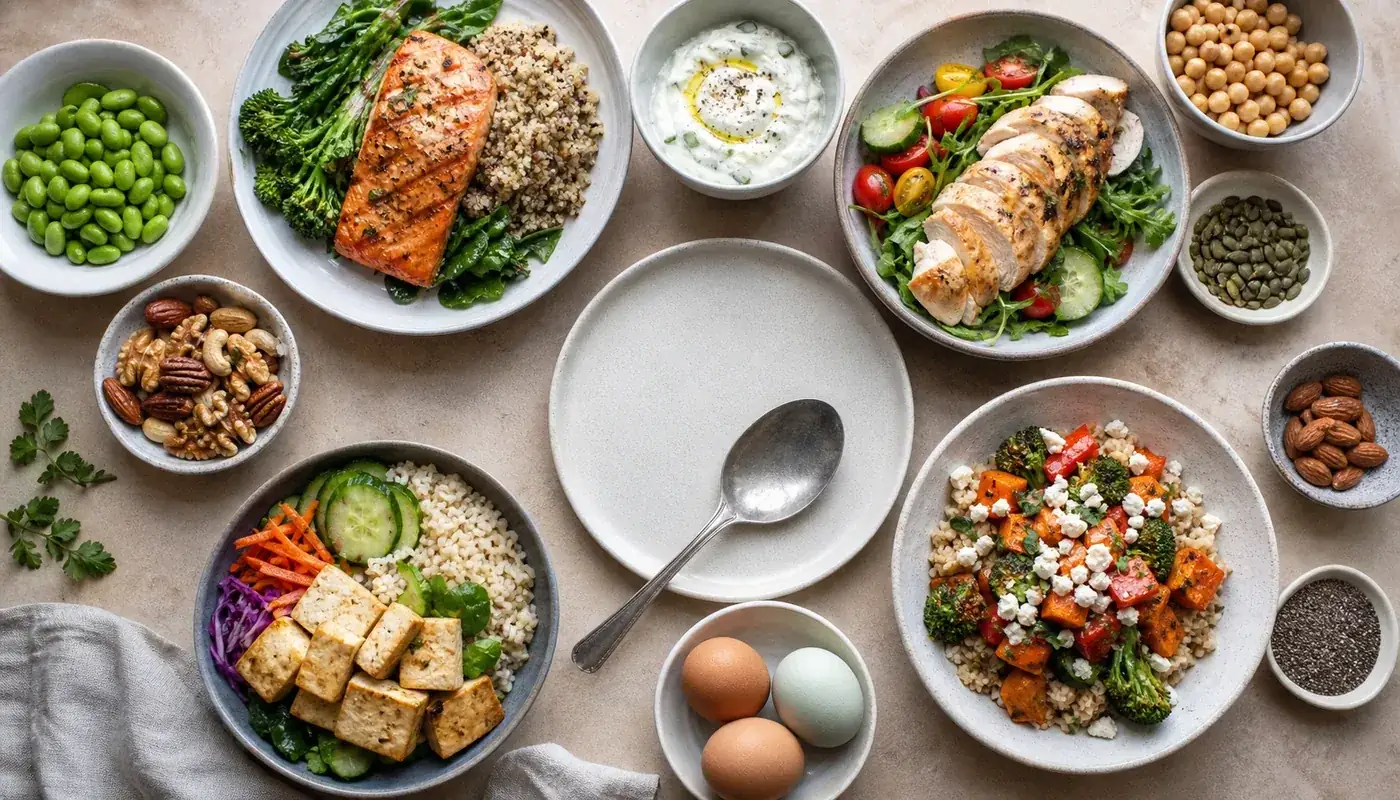
A useful starting point is to identify a clear protein source in your usual meals. That might mean yogurt or eggs at breakfast, beans or tofu at lunch, and fish, poultry, lentils, or another protein food at dinner.
For perspective, a cup of cooked lentils provides roughly 18 grams of protein, while a cup of milk provides about 8 grams. An ounce of almonds supplies about 6 grams. Portions and products vary, so labels are helpful when you need a closer estimate.
These foods also contribute to a meal in different ways. Lentils offer fiber, milk can provide calcium, and nuts bring unsaturated fats. Treating them as interchangeable protein containers misses those useful differences.
Try improving one meal that regularly falls short. Adding tofu to noodle soup or beans to a salad is often easier than redesigning an entire day's eating. The result should still taste like something you want for lunch.
Rough protein in familiar servings
- A cup of cooked lentils, roughly 18 grams
- A cup of milk, about 8 grams
- An ounce of almonds, about 6 grams
- Tofu, soy foods and beans, which vary enough to be worth a label check
- Portions and products vary, so use labels when you need a closer estimate
Plant Protein Counts
You can meet protein needs with plant foods, animal foods, or a combination. A varied plant-based pattern can provide all the essential amino acids without requiring perfectly matched combinations at every meal.
The practical issue is choosing enough substantial protein foods. Beans, lentils, soy foods, peas, nuts, seeds, and grains all contribute, but they differ in protein concentration and amino acid composition. A bowl of vegetables alone is not nutritionally identical to a bowl that also includes tofu or chickpeas.
Soy foods can be particularly useful because they provide all the essential amino acids in meaningful proportions. Other plant foods can complement one another across the day. Rice and beans make a good meal, but there is no need to coordinate every mouthful like a chemistry experiment.
When appetite is limited or needs are high, concentrated options may be convenient. That can mean firm tofu, a higher-protein soy drink, or an appropriate plant protein powder, rather than assuming animal foods are compulsory.
Spread It Out Without Watching the Clock
Including protein across meals is a practical way to reach a daily target and gives muscles repeated access to amino acids. It can also prevent dinner from carrying almost the entire day's assignment.
There is no universal rule that the body can absorb only 30 grams at once. Larger amounts are still digested and used, even though the immediate muscle-building response to a meal has limits and varies with age, activity, and the meal itself.
For most people, the daily total and a workable meal pattern deserve attention before minute-by-minute timing. Eating a meal after training is sensible, but an ordinary workout does not create a tiny window that slams shut before you reach the kitchen.
If breakfast is usually coffee alone, a simple food addition may be more useful than a complicated supplement schedule. Make the routine easier to repeat before trying to make it perfect.
When a Powder Is Worth Considering
Protein powder is convenient concentrated food. It can help when travel, a small appetite, food restrictions, or a busy schedule makes the intended intake difficult. It is optional when regular meals already do the job.
Check the actual protein per serving, allergens, added ingredients, and whether the serving size fits your needs. Independent quality verification can help assess identity and content; it cannot guarantee a training result. A plain product is often easier to evaluate than a blend promising energy, focus, and muscle growth all at once.
Kidney disease can change protein requirements substantially, and dialysis may change them again. That situation needs a tailored nutrition plan rather than a general high-protein target.
For everyone else, a useful approach is pleasantly ordinary: estimate your usual intake, choose a target suited to your circumstances, and close any meaningful gap with foods you enjoy. You do not need to turn every snack into a protein delivery vehicle to feed yourself well.
There is no rule that the body can only use 30 grams at a sitting. Larger meals are still digested and still count.
Worth remembering